Showing posts with label processing. Show all posts

Monday, March 28, 2011

Week Eleven Auxiliar Post: Keeping Things Interesting with a few Photographs


I decided it was time to jazz things up again with some collection photographs.  Below are a few of my favorites thus far.

One of several fantastic pulp mystery magazines from the 1890s--the oldest items in the collection, which precede all others by approximately 50 years.  This particular example, the Young Sleuth Library, is dated 1894.

Another pulp magazine: Old Cap. Collier Library, dated 1890.  I just love the graphic design style on these!

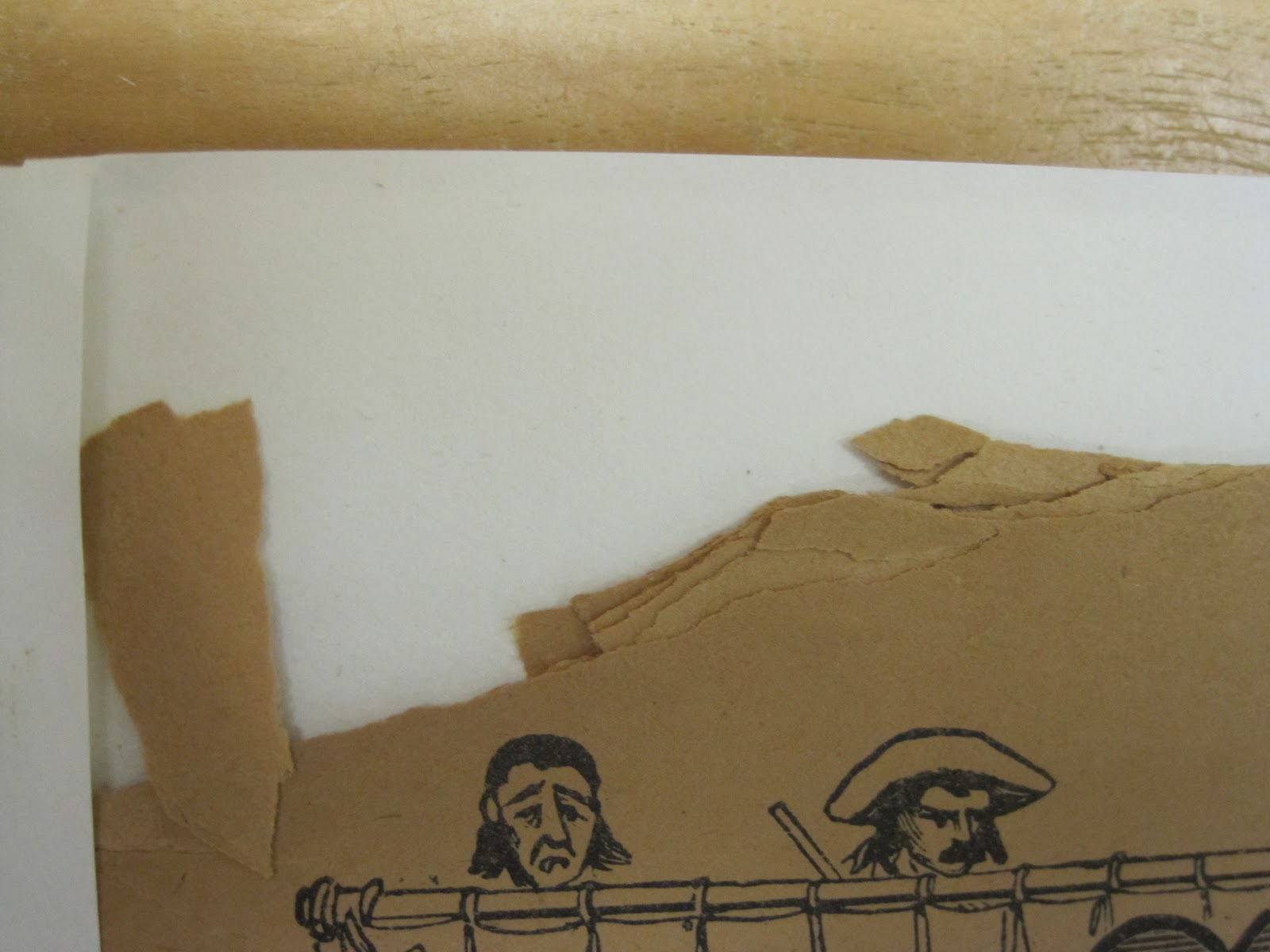
It probably does not come as a huge surprise, but these pulp magazines are extremely brittle and delicate.  Here you can see the corner of one starting to crumble. (Note the unintentional juxtaposition of the crumbling pages and the character's melancholy face at left.. ha!)

Several photographs from the collection.  Most photographic materials, these included, document Edgar Award Dinners throughout the Mystery Writers of America's history.  The Edgar Awards are an annual event for Mystery Writers of America members akin to the mystery novelist's Oscars.  More details to come in next week's post.

Week Eleven: Go Forth and Process

Technically I am cheating--it's already Monday of week twelve and I'm just now recapping week eleven.  My excuse is that I took a much needed quick trip out of town over the weekend, which pushed back my blog post but helped me start this Monday morning feeling refreshed and ready to face the week.  Just five more left weeks left before the end of the semester, and with it the end of my internship at the Lilly.  Every day I am continually reminding myself of the limited time span that I am working with in processing the remainder of the Mystery Writers of America mss.

For the most part, I am moving along at a good pace going through the collection box by box and assigning each folder to its appropriate series.  While processing the Claxon collections, I sorted all materials by series after which I arranged folders within each series.  With this collection, however, I thought it made more sense to pursue both of these tasks at once.  As I arrange the materials, I am also creating the collection inventory and ascertaining date ranges for each folder.  It is my hope that this strategy will allow me to maximize my effectiveness to save time in the long run.  Once series assignment, arrangement within series, and date range assignments are completed and typed up into a shiny new inventory, I just need to double check everything, talk my work over with Craig and Cherry, and start the refoldering process.  Yes, I still have a bit of a ways to go and still need to look at retention issues for financial documents, but I feel good about where I am and my progress thus far.

One reason I devised this particular strategy is that in the case I do not finish processing, I want it to be relatively simple for my successor to pick up where I leave off.  Rather than having folders in haphazard arrangement somewhere between original order at the point of accession and the finished product, the materials and inventory will either be retained in the order present at collection accession or in finished product form (or as close to it as possible prior to supervisor review).  Both forms should be easily intellectually accessible for a new processor.  I think that foresight such as this is essential in maintaining sanity.  As archivists, we are naturally inclined (or at least trained) to document workflows.  My processing strategy is a way of ensuring that my own workflow and rational is documented.  Of course categorization by series is a bit subjective according to the processor's experiences and understanding of the creator; the person who may theoretically pick up on processing may differentiate between folders appropriate for the correspondence series and folders full of correspondence which relate directly to a subject or event in another series slightly differently than I would.  If that sentence did not make sense, here is an example:

There is a correspondence series for which I have thus far assigned general correspondence, correspondence with specific individuals or organizations/offices, and correspondence related to a specific issue (i.e. specific rights disputes, income tax laws).  However, correspondence is also interspersed throughout other topical folders.  When several folders relate to a single event or topic (i.e. Edgar Awards Dinner, anthology publication, etc.), I assigned folders of related correspondence under the event or topical heading rather than a general correspondence heading.  Craig talked this issue over with me and supported my perspective.  Basically, the reasoning behind this arrangement comes about by thinking as a researcher.  Most often, researchers are not purely searching for correspondence.  They are searching for a topic within correspondence.  It is more logical to streamline access by retaining materials of similar subjects together in the same series.  This decision also reflects respect de fonds and/or original order.  However, if processing is picked up by another individual, my reasoning may not be clear.  There may also be interpretive differences between folder relationships by myself and the successor.  So long as I document my choices and consider a transition of hands with foresight, issues such as these should not be a problem.

Otherwise, my processing is going smoothly.  I started to second guess my choice of series when I noticed a fine line between some differentiations (Events and Subjects, Writings and Printed Material), but Craig thought I should stick with my original instincts, which I too think is for the best.  Because this is a decently sizable collection (31 boxes; not huge by any means, but it dwarfs Claxon mss. II), assigning a higher number of series, comparatively speaking, will be a helpful choice benefiting user navigation.  This is at least the goal.

This week (number twelve), I will continue on with processing, beginning with box 5.  Mind you, this number is misleading of my progress, as I initially processed more than ten boxes at the end of the collection before jumping back to number one.  My biggest problem will be figuring out how to manage the growing number of boxes that I'm actively working with in limited processing space.  Surely this is something I will continually encounter in the future!

You'll hear from me again soon.

Thursday, March 17, 2011

Week 10: MWA and a bit of a break

Happy St. Patrick's Day, blog readers! I aligned with my inner librarian today and decided to geek out in green for the occasion. It's only a matter of time before I start wearing eccentric holiday-themed brooches. Haha. To be fair, I saw the Madeleine Albright Brooch Collection exhibition at the Smithsonian over the summer, and it was nothing to be embarrassed about. In fact, it actually made me consider donning a brooch every now and again, though I don't know that I could find or afford any like those on display. In any case, perhaps I'll keep channeling my inner librarian to see if I get the courage and inspiration to go for it.

This week at the Lilly, I continued to process Mystery Writers of America mss. All is going well, but because the collection is so large, it feels like slow going. I've had a relatively easy time assigning series for each folder I encounter, though there are of course a few enigmas. Right now I'm considering the difference between "Writings" and "Printed Material". Perhaps these two series should be joined into one, but when I defined each series individually, there was a definite differentiation. "Writings" was meant to contain manuscript material for books, poems, short stories, screen plays, and other writings written in affiliation with the MWA. "Printed Material" was to contain promotional documents and more ephemeral material, such as brochures, flyers, newspaper clippings, and newsletters. These two categories are clearly related in some sense, and I plan to talk with Craig and Cherry about how to proceed with them next week.

I am also curious as to a small detail when naming files related to a specific event. For example, should a folder be named "Awards dinner 1987" but contain documents dated in the range between 1986-1988, how should the folder be labeled? Should "Awards dinner 1987" remain the title with the 1986-1988 range like this: "Awards dinner 1987, 1986-1988, " or is this too confusing for a researcher? Is it more important to give as much information as possible, accurate dates, or the name of the precise event and corresponding date held? Like I said, small details, but something I'm curious about. If I had no supervisors to turn to and were processing this on my own, I would use the full title plus date range, but this is because I like to include as much information as possible. If, as a processor, I know something about a collection which would be easy to pass on to future users, I generally want to include that information in the inventory or collection description. At the same time, I know that too much text makes a finding aid difficult to browse and mentally digest. Providing over-information may also be a bad habit to start, as though it may be valuable, this practice will likely unnecessarily slow down processing. Given MPLP's proliferation, it's probably safest to err on the side of being a minimalist. Again, something to talk about with Craig next week.

One thing that I really enjoy about keeping this blog is that it forces me to rehash my day-to-day duties and reflect on my strategies, problems, and questions. I often set things aside to revisit later, and reflection helps bring everything back into perspective. Often merely thinking about an issue again once I am outside the context of processing makes me see the potential solutions, reasoning, and repercussions more clearly.

Anyhow, I took some photos of some MWA materials this week. I will share them once I sit down at home with my camera.

Sunday, March 13, 2011

Week Nine: Delving into Mystery Writers of America mss.

After the ninth week of my internship, I find myself in the glorious throws of spring break! This doesn't actually mean much to me this year, as I'll spend my week working, catching up on internship hours that I missed in previous weeks, and applying for jobs(!). Still, there is certainly a different vibe and rhythm to the town this week with most undergraduate students off to warmer climates or heading home for a change of scene. The grocery store was practically empty when I stopped by on Saturday afternoon--a true attestation to migrating populations. I'll enjoy the comparatively empty streets and bus rides to campus in the coming days. The break is also a great forced reality check, making me step back to consider exactly what I need to accomplish in the quick six weeks to come post-break. After the break week's change of pace, I hope to start up again with renewed energy--something quite realistic considering the longer days and gradual greening taking shape in Bloomington.

Enough chatter, back to internship business! The week leading up to spring break was a good one for me at the Lilly. I'm changing gears and diving headfirst into processing the Mystery Writers of America mss. (find the current collection description here). I may refer to the organization as MWA in future references. To quote from the organization's website, the Mystery Writers of America " is the premier organization for mystery and crime writers, professionals allied to the crime writing field, aspiring crime writers, and folks who just love to read crime fiction." On Tuesday, I finished assessing the collection; in physical terms, it includes 31 boxes, some of which were partially processed by the archives at Boston University--the collection's original home. There is already a partial inventory that includes content lists for items in boxes 1-25. Though almost all files are present, organization within boxes does not match that as it appears in the inventory.

While taking my own inventory of MWA mss., I noted some obvious series into which the collection may be organized. At present, materials seem to be inventoried according to some of these obvious series (correspondence, subject files, financial, etc.), however materials often overlap categories. It also seems that the collection came in through several accessions over time, since many of these series are repeated as box numbers progress. I posed this supposition to Cherry, who confirmed that this was indeed the case. The boxes lacking representation in the existing inventory, number 26-31, contain manuscripts (drafts for publications) as well as newsletters, all of which will be simple to itemize and organize into series arrangement.

I submitted a series proposal to Cherry and Craig on Tuesday afternoon, and I received confirmation that most of my ideas are satisfactory. The only thing that we'll need to explore in more depth is the Financial series. At present, we have a number of check stubs, item level receipts, and other similar minute financial documentation not ordinarily retained in institutional repositories, such as the Indiana University Archives. However, because the Lilly's general collection policy and specific MWA mss. acquisition agreement states that no "weeding" (my apologies for using this contentious term!) will be performed on the materials, we may indeed retain these documents. From my initial assessment, it seems that we have at least one or two full cartons containing such documents. It certainly should not be a problem to process these along with the rest of the collection, but then again, should my supervisors and the active Mystery Writers of America group decide that there is low evidential and informational value in the documents, it will be more space effective to remove the items from the collection. The Lilly has an ongoing acquisition with the MWA and will receive future materials at later dates, thus the retention of financial materials in the current collection may well affect what the library acquires in the future. Again, this will not be my decision to make, though I am of course curious as to what the ultimate decision will be. Cherry and I will look at the materials after she returns from a week out of town.

Otherwise, on Thursday I got to processing initial portions of the collection. I decided to start with a box full of Audio and Video materials--cassette tapes, VHS cassettes, and one Beta cassette. I created an inventory for them, as none existed beforehand, and I will deal with proper housing later on. At present they are organized in alphabetical order by title and format. In the past, I've left items such until the tail end of my processing endeavors. This time, I wanted to give them the attention that they deserve at the outset of processing, perhaps because of a recent presentation in my Manuscripts class by IU Film Archivist Rachel Stoeltje. Rachel addressed various material formats and degradation issues that archivists may encounter when processing collections. She also discussed a potential project in the works for Indiana University to build a media preservation laboratory. How exciting! The idea is that IU may become a regional preservation hub for audio and video materials preservation and digitization. Professional consensus is that audio and video objects are not static, and they will not last forever. In order to remain viable and retain content, which lends a unique component to cultural heritage documentation of places and traditions throughout the world, audio and video materials must be continually migrated to usable mediums. At present, transfer to digital media and capturing/linking thorough metadata related to sound/visual content as well as original physicality is the best option for preservation.

Priority for audio and video preservation is something I learned about in-depth last semester, through a great Audio Preservation Principles and Practice course. In case all of my chatter made you curious, you can visit the Sound Directions Project website to learn about a collaborative project jointly pursued by Indiana and Harvard Universities; it provides a great introduction to the state of audio preservation and provides access to specially developed FACET software--potentially a great resource for repositories of all sizes and budgets when analyzing preservation priorities. To quote the website,

"The Field Audio Collection Evaluation Tool (FACET) is a point-based, open-source software tool that ranks audio field collections based on preservation condition, including the level of deterioration they exhibit and the degree of risk they carry. It assesses the characteristics, preservation problems, and modes of deterioration associated with the following formats: open reel tape (polyester, acetate, paper and PVC bases), analog audio cassettes, DAT (Digital Audio Tape), lacquer discs, aluminum discs, and wire recordings. This tool helps collection managers construct a prioritized list of audio collections by condition and risk, enabling informed selection for preservation. Using FACET provides strong justification for preservation dollars."

Many of the issues affecting audio and video materials are similar, though digital audio preservation is, at present, more realistic and "do-able" for most institutions; digital video preservation, on the other hand, requires massive data storage space, making it more difficult for many repositories to pursue at present. Thankfully Indiana University is a large institution with a fantastic computer science and data infrastructure program, meaning such an endeavor may be possible in the not-so-distant future.

And that, readers, is what we call a tangent. I think that means it's time to close. More adventures in processing to come next week as I take on paper-based records!

Best,
Amy

Sunday, February 6, 2011

Week Four: Processing, ice storms, and more processing

I don't mean to sound monotonous, but this week I spent more time *surprise!* processing the Claxon mss. II collection. My hours were truncated a bit on Tuesday due to my paranoia about the ice and snow storm that walloped a large portion of the country this week, but I still managed to make decent progress. As of when I left the Lilly on Thursday afternoon, I had browsed through all files; added date ranges for every folder, subseries, series, and the collection as a whole; and arranged every folder according to the arrangement scheme I discussed with Craig at the outset of my collection analysis. Craig will sort through my work on Friday and/or Monday, and we'll discuss any issues or changes that he identifies.

I feel pretty good about my progress thus far. Though I worry that the arrangement and description of the writings series--which includes approximately two boxes of sermons--leaves a bit to be desired in the way of intellectual access by potential users viewing what will become the collection's finding aid, I feel that this is inevitable with the MPLP ("more product less process" for any of you outside of the archives profession) approach I took to these particular materials. Painstakingly sorting through each item and re-categorizing it according to title, date, Biblical passage, etc. would be incredibly time consuming, disrupt original order imposed by the creator, and present problems in the way of how to deal with items devoid of titles, dates, etc.

As I have discussed with colleagues in the past, sometimes it is best to let the researcher do the research and dig through a collection to see what they can find rather than have the archivist spell everything out. Given burgeoning backlogs, small budgets, ever-expanding professional duties, and the unavoidable constraints of time, interfering with the arrangement to meticulously process collection materials is frequently beyond the professional scope and abilities of archivists at a large volume of institutions.

I am, however, aware that some collections are still meticulously arranged to better provide more direct access to users. For example, at the Indiana University Archives, the Political Papers archivist recently received a grant to be used toward processing the papers of Birch Bayh, a former United States Senator from Indiana. I am not familiar with all the minute details, but I am aware that a number of student workers are assisting with this project by sorting through materials at the item level and meticulously grouping and arranging like materials so as to provide streamlined access to this voluminous collection, which documents Bayh's term as senator. I can certainly see the rational behind this high level of processing, as Bayh played a significant role in state and national political history, and it is expected that this collection may be used relatively heavily. Because the collection is so large, it would be arduous for researchers to access specific topical information if MPLP was employed during collection processing.

Anyhow, I really do need to expand my topics of discussion on here. While I enjoy that this is an outlet for my rational while processing, I also want to highlight some of the materials within the Claxon mss. II collection. I hope to remember to bring my camera in when I intern some time this week. Some of my favorite items include photographs, a memorial sermon written in memory of John F. Kennedy and present by Neville Claxon in Nigeria, hand painted African greeting cards, and a West African recipe booklet. Expect a bit more variety on the blog in weeks to come.

On an aside, have a good Superbowl Sunday! Though I am not a huge football fan, I enjoy the idea of it as a collective American experience. Relatedly, one of the major concepts that attracts me to archives is the documentation of collective history. I assume that the National Football League has archival holdings somewhere--be it in its own archives or at an existing archival institution--through which people of all backgrounds can connect through shared memories and events.

Cheers,
Amy